
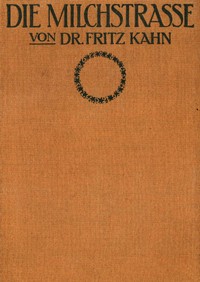
Die Milchstraße by Fritz Kahn
Let's be clear: Die Milchstraße (The Milky Way) isn't a dry science textbook. Fritz Kahn, a doctor and science writer in the 1920s, had a mission: make the colossal scale of our galaxy understandable. Without satellites or Hubble images, he turned to metaphor. The book walks you through his brilliant, often domestic, comparisons.
The Story
There isn't a plot with characters. Instead, Kahn builds a picture layer by layer. He starts with the night sky we can see, then pulls back the curtain. He compares the shape of our galaxy to two fried eggs pressed together, or to a vast, slow-moving whirlpool where we live out on one of the spiral arms. He imagines what it would be like to view it from the outside, mapping it like a city with a downtown core of ancient stars and suburban sprawls of newer ones. The 'story' is the journey of your own understanding, guided by his clever, tangible ideas.
Why You Should Read It
I loved this for its pure, inventive spark. It's a time capsule of scientific thought, but more importantly, it's a masterclass in explanation. Kahn's genius was knowing that to grasp something huge, you first need a handle you can hold. His metaphors are so vivid you almost forget how advanced the concepts are. It makes you appreciate both the wonder of the galaxy and the wonder of the human mind trying to describe it. It’s humble and ambitious at the same time.
Final Verdict
This is a perfect read for curious minds who enjoy 'big idea' books, fans of science history, or anyone who loves beautiful, clever explanations. If you like the style of writers like Carlo Rovelli or Neil deGrasse Tyson, you'll meet their intellectual great-grandfather here. It's a short, sparkling reminder that the best science writing doesn't just inform—it delights.
This work has been identified as being free of known copyright restrictions. Feel free to use it for personal or commercial purposes.
George Harris
9 months agoFrom a researcher's perspective, the argument presented in the middle section is particularly compelling. It’s hard to find this much value in a single source these days.
Paul Smith
2 years agoThe citations provided are a goldmine for further academic study.
William Hernandez
10 months agoThe research depth is palpable from the very first chapter.
James Lopez
10 months agoI wanted to compare this perspective with traditional views, the logic behind each conclusion is easy to follow and verify. A trustworthy resource that I'll keep in my digital library.



Susan White
3 months agoClear, concise, and incredibly informative.