
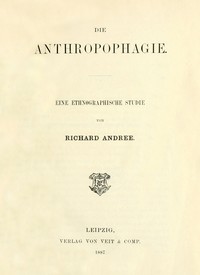
Die Anthropophagie by Richard Andree
Published in 1887, Richard Andree's 'Die Anthropophagie' is a methodical study of the practice of cannibalism across the globe. The book acts as a massive catalog, pulling from explorers' journals, missionary reports, and historical texts. Andree organizes the information geographically, taking the reader from the islands of the Pacific to the heart of Africa and the forests of the Americas. He presents the accounts he found, often without heavy judgment, letting the raw descriptions speak for themselves.
Why You Should Read It
This isn't just a shock-value list of horrors. Andree's work forces you to consider context. He distinguishes between survival cannibalism, ritualistic practices, and acts of war. Reading it, you're confronted with the uncomfortable reality that this taboo wasn't universal; for some cultures, it was embedded in spiritual beliefs or social structure. The book's power comes from its stark compilation. It doesn't give easy answers, but it gives you the raw material to ask better questions about cultural relativism and the very edges of human behavior.
Final Verdict
This is a niche but fascinating read. It's perfect for history buffs and true crime enthusiasts who enjoy primary sources, or for anyone interested in the early days of anthropology. Be warned: the subject matter is heavy and the descriptions are graphic by 19th-century standards. It's not a casual beach read, but if you're looking for a book that will genuinely make you stop and ponder, this dense, unsettling survey is it. Think of it as a time capsule of how the Victorian world tried to make sense of the unfamiliar.
This historical work is free of copyright protections. Thank you for supporting open literature.
David Moore
1 year agoInitially, I was looking for a specific answer, but the author clearly has a deep mastery of the subject matter. I’ll definitely be revisiting some of these chapters again soon.
John Lee
8 months agoAs a long-time follower of this subject matter, the inclusion of diverse viewpoints strengthens the overall narrative. I feel much more confident in my knowledge after finishing this.
Charles Smith
9 months agoThe layout of the digital version made it easy to start immediately, the objective evaluation of the pros and cons is very refreshing. This has become my go-to guide for this specific topic.
Mary Anderson
2 years agoAfter spending a few days with this digital edition, the transition between theoretical knowledge and practical application is seamless. This adds significant depth to my understanding of the field.



George Taylor
1 month agoI've gone through the entire material twice now, and the level of detail in the second half of the book is truly impressive. I'm genuinely impressed by the quality of this digital edition.