
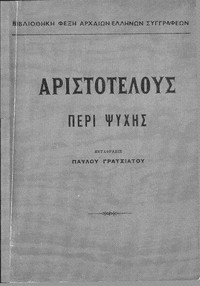
Περί Ψυχής by Aristotle
So, here's the setup: Aristotle isn't telling a story with characters and a plot. Instead, he's on a mission. He's systematically investigating the concept of 'psuchē' (soul or life-force). He starts by reviewing what other big thinkers of his day said about it, then tosses out the ideas he finds shaky.
The Story
The 'story' is his argument. He builds it piece by piece. First, he defines the soul not as a separate ghost in the machine, but as the 'form' or actualizing principle of a living body. It's what makes a seed grow into a tree, or what gives you the capacity to think and feel. He then breaks down the different 'powers' or functions of the soul: the basic power of nutrition and growth (plants have this), the power of perception and movement (animals have this too), and the power of reason (that's us humans). The whole book is him connecting these dots, showing how these powers build on each other to create the hierarchy of life we see around us.
Why You Should Read It
Reading this is like getting a backstage pass to the birth of Western science and psychology. You're watching a genius try to make sense of the world using only his eyes, his brain, and relentless curiosity. It's humbling and thrilling. You'll catch yourself thinking, 'Whoa, he's basically describing how a nervous system might work!' centuries before anyone had the tools to prove it. It's not always easy—he circles back on ideas and gets technical—but the core insight is stunningly simple and profound: your mind and your body aren't two things; they're two sides of the same living, breathing coin.
Final Verdict
This is for the curious reader who doesn't mind a little mental heavy lifting. It's perfect for anyone interested in the history of ideas, the roots of biology and psychology, or anyone who's ever looked at their pet or a plant and wondered, 'What's the difference between us?' It's not a light beach read, but it's one of the most foundational and surprisingly relevant books you'll ever encounter. Think of it as the original owner's manual for being alive.
This book is widely considered to be in the public domain. Enjoy reading and sharing without restrictions.
William Johnson
1 year agoThis work demonstrates a clear mastery of contemporary theories.
Susan Anderson
1 month agoInitially, I was looking for a specific answer, but the historical context mentioned in the early chapters is quite enlightening. I am looking forward to the author's next publication.
Thomas Martin
1 year agoIt took me a while to process the complex ideas here, but the narrative arc keeps the reader engaged while delivering factual content. Simple, effective, and authoritative – what else could you ask for?
Paul Anderson
2 years agoGiven the current trends in this field, the objective evaluation of the pros and cons is very refreshing. A rare gem in a sea of mediocre content.


Sarah White
1 year agoExactly what I was looking for, thanks!